
BOP Mason Release Scope
The Federal Bureau of Prisons is part of the U.S. Department of Justice and confines sentenced federal prisoners. No BOP prison was identified in Mason County. The federal page applies because a person connected to Mason County may serve a federal sentence elsewhere, not because BOP operates the local or regional jail. Western Regional Jail and WVDCR remain the first routes for state and county custody.
A federal defendant may leave BOP for the community, supervised release, another justice system, or an immigration detainer. Supervised release is a court-ordered federal supervision term after prison. It is not BOP confinement, yet it means legal obligations continue. A detainer release sends the person to the authority holding the detainer. That is a transfer of physical custody, not a street release.
Mason County’s local custody geography supplies a useful cross-check. Western Regional Jail serves Mason from a site in Cabell County, while Lakin Correctional Center and Jail is a statewide women’s prison physically in Mason County. Neither building is a BOP prison. A search should move to BOP only when the federal judgment or confirmed custody chain supports it, not because a person left either state facility.
Search BOP Released Prisoners
The BOP Inmate Locator covers federal prisoners incarcerated from 1982 to the present. Search by the federal register number in its number format when known. A name search can use first, middle, and last name with race, sex, and age filters. Compare all returned identifiers because common names can produce several results.
Use a short lookup sequence:
- Confirm that the underlying case is federal through the court docket or known sentence.
- Search the exact register number, or use the full name and available filters.
- Compare name, register number, age, race, sex, location, and release date fields.
- Record the precise BOP wording, such as “Released” or “Not in BOP Custody.”
- Check the federal docket, U.S. Probation, or receiving agency for what happened next.
BOP results commonly include name, register number, age, race, sex, release date, and location. Calculated release dates can change. Older federal records before the locator’s coverage require other archival or agency routes. A BOP result should never be substituted for the WVDCR jail or prison searches just because a Mason County case involved a task force.
Note: BOP identifies federal custody; it does not report every state, local, immigration, or U.S. Marshals movement.
Read BOP Release Results
“Released” and a release date establish departure from BOP custody as reported. “Not in BOP Custody” has the same narrow boundary. The person may be under federal supervised release, serving a state sentence, held by ICE, or in another sovereign’s custody. Sovereign means a government authority, such as the federal government or a state, that has its own legal basis for custody.
| BOP clue | Next confirmation |
|---|---|
| Released with date | Federal docket, release paperwork, and U.S. Probation if ordered. |
| Not in BOP Custody | Check whether another authority or supervision term applies. |
| Future release date | Treat as calculated and subject to lawful change. |
| Different location | Confirm whether it is a BOP transfer rather than a release. |
The federal court docket supplies sentencing, modification, revocation, and supervision orders. It does not always show the exact gate time. The BOP release event supplies the reported physical custody change. U.S. Probation can address supervision routing, though individual information may be restricted. Pairing the sources prevents a release date from being mistaken for the end of the federal sentence.
BOP Release Notice Fields
BOP’s Notice of Release and Arrival form illustrates why destination matters. Its fields include release date and method, releasing institution, community versus detainer destination, transportation, supervision agency, and reporting obligation. Those categories can separate a community departure from a handoff. They also show why the locator alone may not answer where the person went.
- Community destination
- A release route outside physical confinement, possibly with supervision.
- Detainer destination
- Transfer to an agency with another lawful custody claim.
- Supervised release
- Federal court supervision after prison, administered through U.S. Probation.
- Release method
- The official category used by BOP for the departure.
Access to a person-specific form or underlying record may depend on privacy rules and exemptions. A request should identify the exact item and date range rather than seek an entire correctional file. BOP’s FOIA office is the federal records route. State FOIA deadlines and WVDCR copy policies do not govern federal BOP requests.
Request BOP Release Records
When the locator is insufficient, use BOP FOIA for agency records. Give the full name, federal register number, date of birth if known, releasing institution, and a narrow date range. Ask for the segregable portion of the release record or Notice of Release and Arrival, including release date and method, destination category, and supervision or reporting agency where public.
Privacy law and FOIA exemptions may limit a third party’s access. Requesters seeking their own records can follow BOP’s identity-verification rules. If material is withheld, read the stated basis and use the agency’s appeal process when appropriate. A federal docket document may independently establish the sentence and supervision order even when BOP cannot disclose all institutional details.
The official BOP locator interface is pictured below. It is the valid federal search source for this facility-system page, not a Mason County roster.
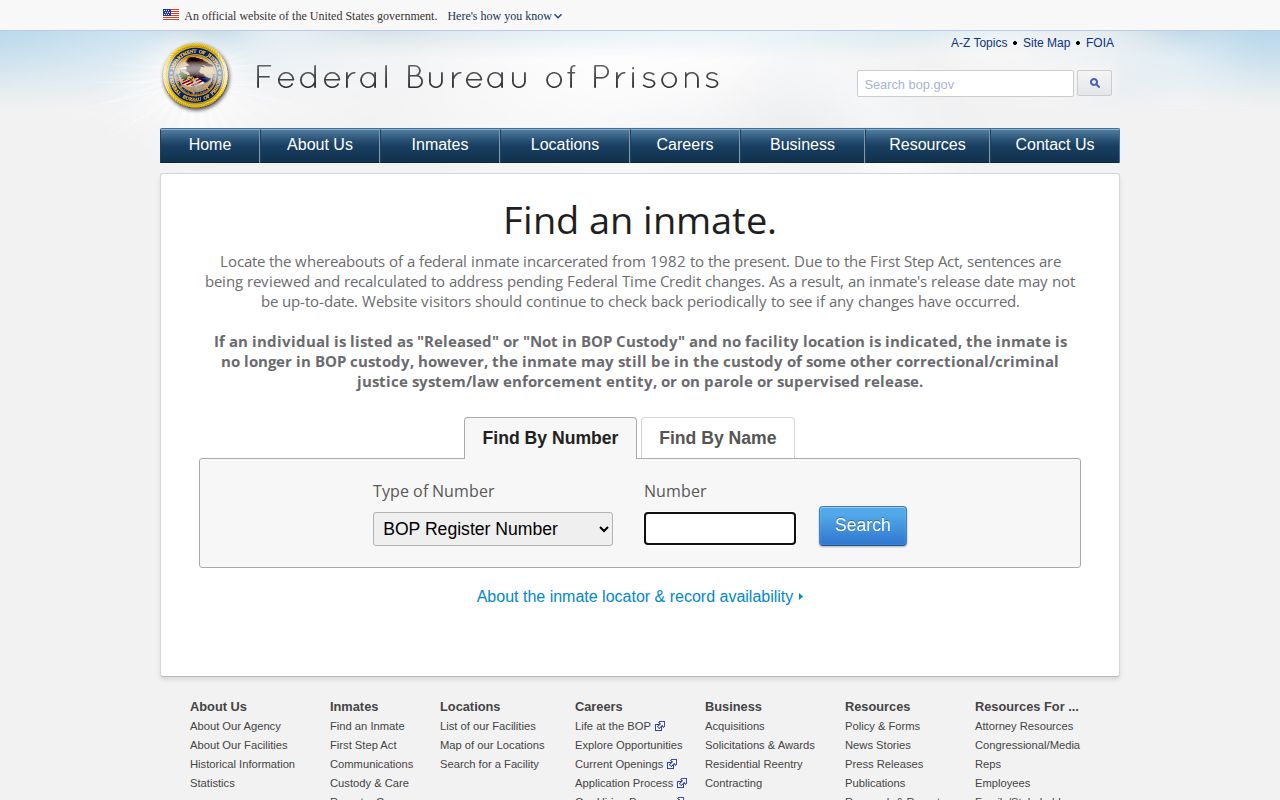
The captured interface should be checked live because form fields, wording, and federal records can change after capture.
BOP Release to Detainers
A detainer can change the destination at the end of a BOP term. State authorities, immigration authorities, or another jurisdiction may have a lawful basis to take custody. BOP release paperwork can identify a detainer destination, but the receiving agency becomes the source for later status. The BOP locator may then correctly say the person is no longer in BOP custody while confinement continues elsewhere.
For immigration custody, use ICE’s Online Detainee Locator when its criteria fit. For a state sentence, use that state’s corrections system. For a West Virginia state prisoner, use WVDCR’s prison search. A U.S. Marshals movement may require the federal docket, case counsel, or official contacts because no public nationwide former-detainee locator comparable to BOP was verified.
The Mason County released-inmate record path distinguishes these systems when a person’s federal status is uncertain. It keeps a BOP result from replacing the Western jail record or state-prison record.
Note: Release to a detainer closes BOP custody but begins or continues custody under the receiving authority.
Verify Mason Federal Release
Start by proving the federal case. The federal court docket identifies the court, case number, sentence, later modifications, and supervised-release terms. Next, use the BOP locator for the physical-custody status and release date. Then identify U.S. Probation or another receiving agency. Each source answers one part, and no single result establishes the whole post-release position.
A federal arrest without a BOP sentence may involve U.S. Marshals pretrial custody or a contract detention site. BOP may not be the correct lookup. Likewise, a state arrest involving federal agents can remain a state matter. The charging court and judgment determine which system applies, not the name of an investigative agency in a news report.
The final description should remain exact: released from BOP custody on the listed date, not in BOP custody as of the search, transferred to a detainer, or subject to a federal supervision order. Avoid claiming final discharge unless the court and supervision records support it. That precision protects the line between prison release and the legal obligations that can follow.
Federal sentence dates also require care. BOP may calculate a release date from the judgment, applicable credit, and later changes. The result can move. A court modification, disciplinary credit issue, or another lawful event may affect the date without rewriting the original judgment. The locator’s date should therefore be recorded as the BOP field seen at the time of search. For an authoritative historical question, seek the underlying agency record and the court filings rather than relying on a saved portal image alone.
A person on federal supervised release reports through the district and office set by the court and U.S. Probation. Supervision may be transferred to another district even though the criminal judgment came from the original court. The public docket can show later revocation or modification proceedings, but routine supervision details may not be public. Ask only for information the office can lawfully confirm and do not treat the absence of a public supervision search as proof that the term ended.
Older federal prisoners need a different records path because the locator’s stated coverage begins with people incarcerated from 1982 forward. Archival court records, BOP FOIA, and other federal record systems may be needed. A name mismatch or missing number can also defeat a search. Try verified name forms and the register number before concluding no federal record exists.
Finally, keep the Mason County connection factual. The person may have lived in Mason County, been arrested there, or have family there while the federal case and prison sit elsewhere. The BOP result is national. It should not be described as a county release record, and it should not be mixed with Western Regional Jail admissions or WVDCR state-prison status.